Connecticut's Hurricane Deductible: the 33 Towns, the 2,600-Foot Line, and the 74 MPH Trigger
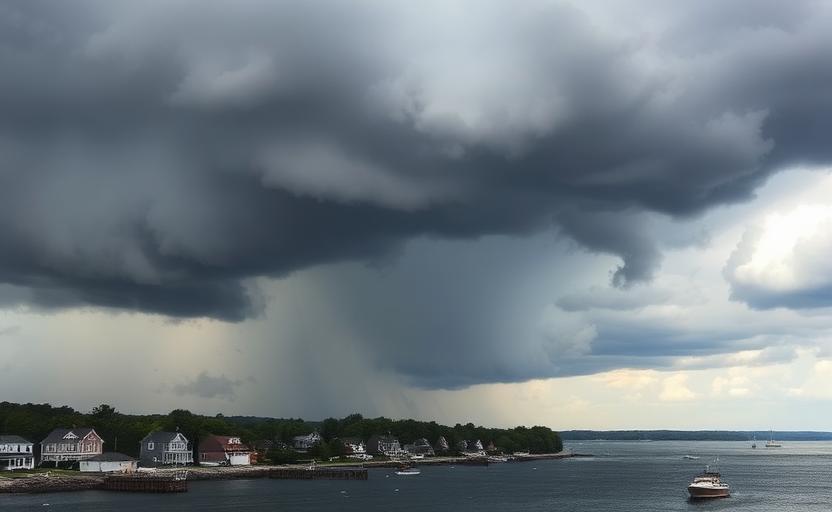
A percentage hurricane deductible on a multi-million-dollar Connecticut shoreline home is a six-figure number most owners have never actually computed. Here is exactly when it applies, how much, and where.
The Number Nobody Computes Until the Storm Already Happened
Every coastal Connecticut homeowner has heard the phrase "hurricane deductible." Very few have actually run the number on their own house. On a home insured for several million dollars, the difference between a flat-dollar deductible and a percentage deductible is not academic — it is tens or hundreds of thousands of dollars, decided months before any storm forms, by language sitting quietly on the declarations page.
What Triggers It: the 74 MPH Rule
Connecticut regulates hurricane deductibles more narrowly than the "named storm" language used in many other coastal states. A hurricane deductible in Connecticut may only be activated when two conditions are met at once: the National Hurricane Center has a hurricane warning in effect for any part of the state, and the storm produces sustained winds of more than 74 miles per hour somewhere in the state. The deductible period runs from the moment that warning is issued through 24 hours after the warning is either removed or downgraded.
That is a materially higher bar than many owners assume. A tropical storm, or even a hurricane that weakens before landfall, will often not meet it. According to CT Mirror's reporting on the current standard, adopted after confusion over how deductibles were applied during Tropical Storm Irene (2011) and Storm Sandy (2012), the clarified trigger has not actually been activated in Connecticut since. Separately, ordinary windstorm and hail deductibles are permitted statewide but cannot be mandated by an insurer — a hurricane deductible is the one deductible type Connecticut allows a carrier to require, and only under the conditions above.
Where It Applies: 33 Towns, and a Hard Line at 2,600 Feet
Hurricane deductibles are not available to Connecticut insurers statewide — only in a defined set of coastal communities. That list covers the 24 towns bordering Long Island Sound, from Greenwich east to Stonington, plus nine additional communities Connecticut treats as coastal for this purpose even though they sit slightly inland: North Branford, Orange, Essex, Deep River, Chester, Killingworth, North Stonington, Ledyard, and Lyme. Thirty-three towns in total.
Within those towns, the deductible percentage a carrier may charge depends on a specific, hard distance line. Dwellings located within 2,600 feet of the Connecticut shoreline may be charged a hurricane deductible of up to 5% of the dwelling limit. Beyond 2,600 feet but still within an eligible coastal town, the cap drops to 2%. In both cases, a carrier may charge less than the cap but not more. The Connecticut FAIR Plan's own published terms describe this exact structure for its own coastal book: dwellings within 2,600 feet of the shoreline carry two separate deductibles, one for ordinary named perils and a separate hurricane deductible expressed as a percentage of the dwelling limit.
The 2,600-foot line is measured as the crow flies from the shoreline, not by road distance or by flood zone — a property can sit outside a mapped flood zone and still fall inside the 2,600-foot hurricane-deductible corridor, or vice versa. The two are different measurements answering different questions. See our Connecticut flood insurance guide for how flood-zone determination works separately from this distance rule.
What This Actually Costs on a High-Value Home
Because the deductible is calculated as a percentage of the dwelling limit rather than the size of the loss, it scales directly with how the home is insured — and it applies before the carrier pays anything. On a home insured for $4 million within the 2,600-foot line, a 5% deductible is $200,000 out of pocket before any hurricane claim payment begins. On the same home just beyond that line, a 2% deductible is $80,000. Neither number resembles the flat, four-figure deductible most owners picture when they hear "deductible," and few owners have actually pulled their declarations page to see which percentage — and which trigger — their own policy uses.
What to Do With This Information
- Confirm your own trigger language. Some carriers write a broader named-storm trigger that can attach even when a storm never reaches hurricane strength — narrower and more favorable than the state's floor is not guaranteed on every form, and some policies are less generous to the homeowner than Connecticut's baseline requires them to be no worse than.
- Confirm what the percentage applies to. Usually the dwelling limit alone, but some forms apply it to combined dwelling, other structures, and personal property limits together.
- Ask about a flat-dollar buy-down. Some carriers and private-client programs offer the option to replace the percentage deductible with a flat dollar amount for an additional premium — a meaningful feature on a high-value home, and one that has to be requested rather than assumed.
- Review wind and flood together. A single hurricane can produce both a wind claim and a flood claim under two separate policies with two separate deductibles.
Ready to Secure Your Coverage?
Get personalized insurance recommendations from our expert agents. Schedule your consultation today.
📅 Schedule a ConsultationThis deductible is worth understanding before the August-through-October peak of hurricane season, not during it. Contact New England Insurance to find out exactly which trigger and which percentage apply to your own Connecticut property, and whether a buy-down is available.
Start Your Coverage Review
Share your risk picture and a licensed advisor will design coverage tailored to your specific needs.